IVR System UAE: What Businesses Should Expect from a Modern Setup
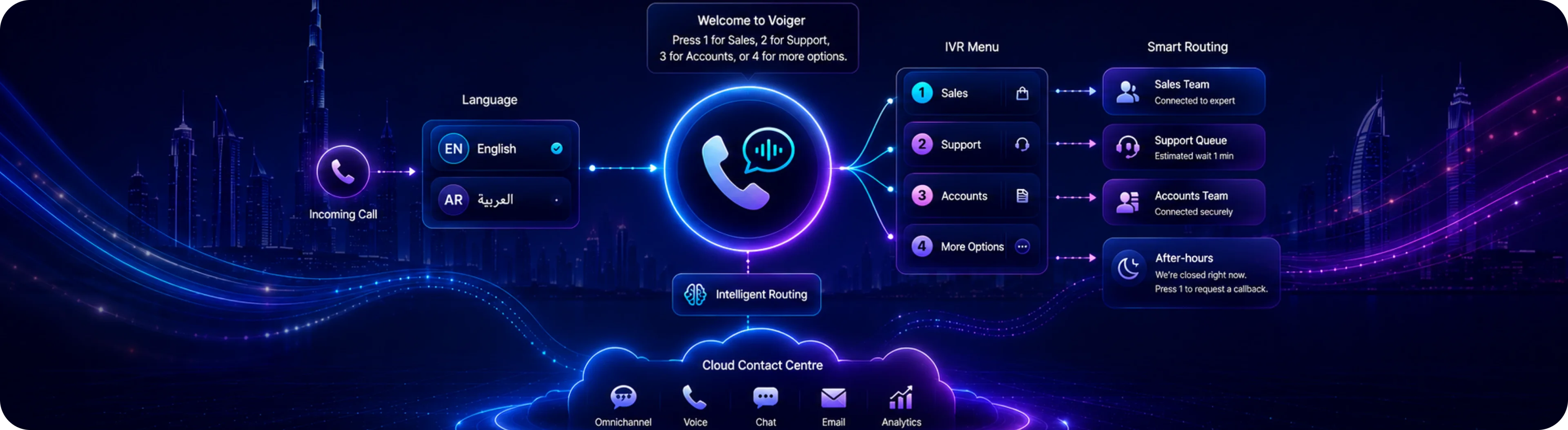
Table of contents
For many businesses, IVR is one of the first layers of customer communication automation they ever introduce.
It is familiar.
It is widely used.
It creates structure around inbound calls.
“Press 1 for sales. Press 2 for support. Press 3 for accounts.”
For years, that was enough.
But customer expectations have changed.
Businesses in the UAE now need more than a basic phone menu. They need customer communication that feels clearer, faster, and better aligned with how real teams work. They also need routing that supports sales, support, multiple languages, after-hours handling, and distributed operations without creating unnecessary friction.
That is why the question is no longer just:
“Do we have an IVR?”
The better question is:
“Is our IVR system actually helping customers reach the right outcome?”
If your business is evaluating an IVR system in the UAE, here is what a modern setup should include, where IVR still adds value, and what to expect before choosing a platform.
Ready to Explore What a Better IVR Setup Could Look Like?
UAE-built cloud contact centre from AED 299/month. Etisalat & du integration, TDRA-compliant, GCC hosting. BYOC/BYOB, AI voice & analytics, 24/7 UAE support. Go live in 5 days.

What an IVR System Actually Does
IVR stands for Interactive Voice Response.
It is a call-handling system that helps direct callers through a structured path using menu options, keypad input, or simple voice prompts.
At a basic level, an IVR system helps businesses:
answer inbound calls consistently
direct callers to the right team or department
reduce manual call transfers
provide structure during busy periods
handle calls outside standard business hours
guide customers before an agent answers
That is why IVR is still a core part of many cloud contact centre UAE and contact centre software UAE environments.
The problem is not that IVR is outdated.
The problem is that many IVR systems were designed for older customer expectations and older operating models.
Why Many Businesses in the UAE Still Struggle with IVR
A lot of businesses technically have an IVR, but it is not creating a good experience.
Customers often face:
too many menu layers
unclear options
slow navigation
generic prompts
routing that does not match the real issue
no useful after-hours path
repeated transfers even after selecting an option
In those cases, the IVR exists, but it is not helping enough.
That is why businesses searching for an IVR system UAE solution are often not asking for an IVR for the first time.
They are looking for a better version of the one they already have.
What a Modern IVR System Should Actually Include
A modern IVR system should not just be a menu tree.
It should be part of a broader, more practical customer communication workflow.
Here is what businesses should expect from a more capable setup.
The best IVR systems are usually the clearest, not the most complex.
A customer should be able to understand:
what options are available
which one applies to their need
how quickly they can reach the next step
A modern IVR should reduce confusion, not create more of it.
That means:
fewer unnecessary menu layers
plain language
logical menu grouping
options based on real customer needs, not just internal departments
2. Smarter Routing Logic
A good IVR should connect with the routing model behind it.
That means it should support routing by:
team
service type
language
business hours
priority
queue rules
user availability
This is where IVR becomes much more useful.
It stops being only a greeting layer and becomes part of a stronger call routing software UAE workflow.
3. Better Language Handling
This matters a lot in the UAE.
Many businesses serve Arabic-speaking and English-speaking customers, and sometimes additional language groups as well.
A modern IVR system UAE should make language selection easy and natural.
This helps:
improve customer comfort
reduce early frustration
route calls to the right team faster
create a more professional first impression
For multilingual businesses, language support is not optional.
It is part of a better customer experience.
4. Better After-Hours Handling
A modern IVR should not go silent when the office closes.
Businesses should expect an IVR setup that supports:
after-hours call flows
callback request handling
voicemail alternatives
clear messaging during closed hours
AI voice handoff where useful
a more professional path for inbound callers outside working hours
This is especially valuable for sales-led and enquiry-heavy teams.
5. Integration with a Cloud Contact Centre
IVR works best when it is not isolated from the rest of the communication environment.
A modern IVR should sit inside a broader cloud contact centre UAE or contact centre as a service UAE model where it can support:
queue management
agent availability logic
reporting
supervisor visibility
CRM or support workflows
future AI and analytics capabilities
This is what makes IVR much more useful in practice.
Why IVR Is Still Relevant in a Modern Contact Centre
There is a lot of focus in the market right now on AI voice bots and conversational automation.
That is understandable.
But IVR still has a real role.
It remains useful when the business needs:
a clear first layer for inbound calls
predictable routing structure
queue direction by department or function
language selection
simple after-hours guidance
a manageable rollout path without overcomplicating the first step
For many UAE businesses, IVR is still a practical part of the call flow.
The important point is that it should be designed well and supported by a stronger cloud communication setup around it.
What Bad IVR Looks Like
Sometimes the easiest way to understand what a modern IVR should do is to look at what poor IVR still sounds like.
A weak IVR setup usually has one or more of these problems:
menus that are too long
options that do not reflect real customer needs
generic prompts that confuse callers
poor routing after the menu choice
no language flexibility
no helpful after-hours path
no alignment between the IVR and actual team structure
too much dependency on manual transfer after the caller chooses an option
This leads to:
more caller frustration
weaker customer confidence
longer handling time
more transfers
more operational pressure on teams
That is why “having an IVR” is not enough on its own.
The quality of the setup matters.
IVR vs AI Voice: What Businesses Should Expect
A modern IVR system and AI voice do not need to compete with each other.
In many cases, they work best together.
An IVR system is strong when the business needs:
structured call paths
clear routing logic
language selection
predictable first-line navigation
AI voice is strong when the business wants:
more natural conversation
after-hours lead capture
basic qualification
more flexible support triage
conversational self-service
better first-line automation before handoff
This is why many businesses first improve the IVR layer, then later add AI voice bot UAE capabilities where they create more value.
A strong IVR setup can still be a good foundation for that evolution.
Why IVR Matters for Sales Teams
Sales teams often think of IVR as more of a support feature, but it matters for sales too.
A better IVR setup can help sales teams by:
directing new enquiries quickly
reducing the risk of missed or misrouted leads
separating project, service, or department calls more clearly
improving after-hours handling
creating cleaner first touchpoints for inbound interest
For businesses that depend on inbound calls, a poor IVR can quietly reduce conversion opportunity.
A good IVR helps the lead reach the right place faster.
Why IVR Matters for Support Teams
Support teams feel the impact of IVR every day.
When IVR is poor, support teams deal with:
more misrouted calls
more repeated explanations
more customer frustration
more internal transfers
slower issue handling
A stronger IVR helps support teams by:
directing customers to the right queue
making language-based handling easier
improving after-hours communication
reducing manual call distribution
supporting more structured service workflows
This is why IVR quality has a direct effect on support quality.
What Businesses in the UAE Should Prioritise First
If your team is evaluating an IVR system in the UAE, these should be the first priorities.
If the menu is confusing, the whole experience starts badly.
2. Routing Fit
The IVR should reflect how your business actually handles calls.
3. Language Support
A multilingual customer base requires a practical language path.
4. After-Hours Experience
The business should still give callers a useful experience outside working hours.
5. Integration with Broader Contact Centre Workflows
The IVR should support queues, reporting, and workflow structure instead of sitting on its own.
These priorities create much more value than simply adding more menu layers.
What to Ask Before Choosing an IVR System in the UAE
If your business is evaluating providers, ask these questions early:
Will the IVR reflect how our business actually handles inbound calls?
Can the routing support team, language, service type, or business hours logic?
How easy is it to keep the menu simple and clear?
What happens after hours?
Will the IVR connect with our broader cloud contact centre workflow?
Can we add AI voice later if needed?
Will managers have visibility into how calls move through the flow?
How easy is it to update the IVR as our business changes?
These questions help move the conversation from “Do you have IVR?” to “Will this IVR actually improve the customer experience?”
Why This Matters for UAE SMB and Mid-Market Businesses
Large enterprises may have dedicated telecom teams and more resources to manage complex IVR design.
SMB and mid-market businesses in the UAE usually need something more practical.
They need:
a clearer customer experience
less routing friction
easier updates
support for multilingual customers
a better fit for sales and support workflows
room to grow into AI and analytics later
That is why a well-designed IVR system UAE setup matters so much for this segment.
It creates immediate operational value without requiring a heavy transformation project.
The Bottom Line
A modern IVR system in the UAE should do more than answer calls with menu options.
It should help customers reach the right path faster, support multilingual communication, improve after-hours handling, and fit into a broader cloud contact centre workflow.
For many businesses, IVR is still an important part of a strong customer communication setup.
The difference is that today’s IVR should be:
clearer
smarter
easier to navigate
better aligned to real customer journeys
connected to routing, reporting, and future AI capability
That is what businesses should expect from a modern setup.
Ready to Explore What a Better IVR Setup Could Look Like for Your Business?
Voiger helps businesses modernise customer communication with practical cloud contact centre workflows, smarter routing, and flexible IVR setups built around real sales and support operations.
If your team is evaluating an IVR system UAE solution, book a demo with Voiger to explore a setup that creates a better experience for both customers and teams.

Frequently asked questions
Everything you need to know about Voiger Voice Platform.
An IVR system, or Interactive Voice Response system, is a call-handling setup that helps direct callers through menu options and routes them based on the business’s defined call flow.
IVR is still useful because it creates structure for inbound calls, improves routing, supports language selection, and helps businesses handle calls more consistently.
A modern IVR system should be clearer, easier to navigate, better integrated with routing and queue logic, and more aligned with real customer needs than older menu-based setups.
Many UAE businesses serve customers in Arabic and English, so language-based IVR paths help improve clarity, comfort, and faster routing to the right team.
Yes. A strong IVR can support after-hours call handling by providing clear guidance, callback flows, voicemail alternatives, or integration with AI voice workflows.
They serve different roles. IVR is useful for structured call navigation, while AI voice is useful for conversational handling, qualification, and more flexible automation. Many businesses use both together.
It helps route enquiries faster, reduce misdirected calls, support after-hours call handling, and create a cleaner first interaction for inbound prospects.
It helps support teams by improving queue routing, language-based handling, after-hours communication, and reducing avoidable transfers or repeated explanations.
AI Call Centre UAE: Where AI Actually Adds Value for Sales and Support Teams
June 16, 2026
NaaS UAE: Why Network as a Service Matters for Voice Quality, Rollout, and Reliability
June 11, 2026
Cloud Contact Centre Abu Dhabi: What Service-Led Businesses Should Prioritise
June 4, 2026