PRI UAE: What Businesses Should Know Before Choosing a PRI Service
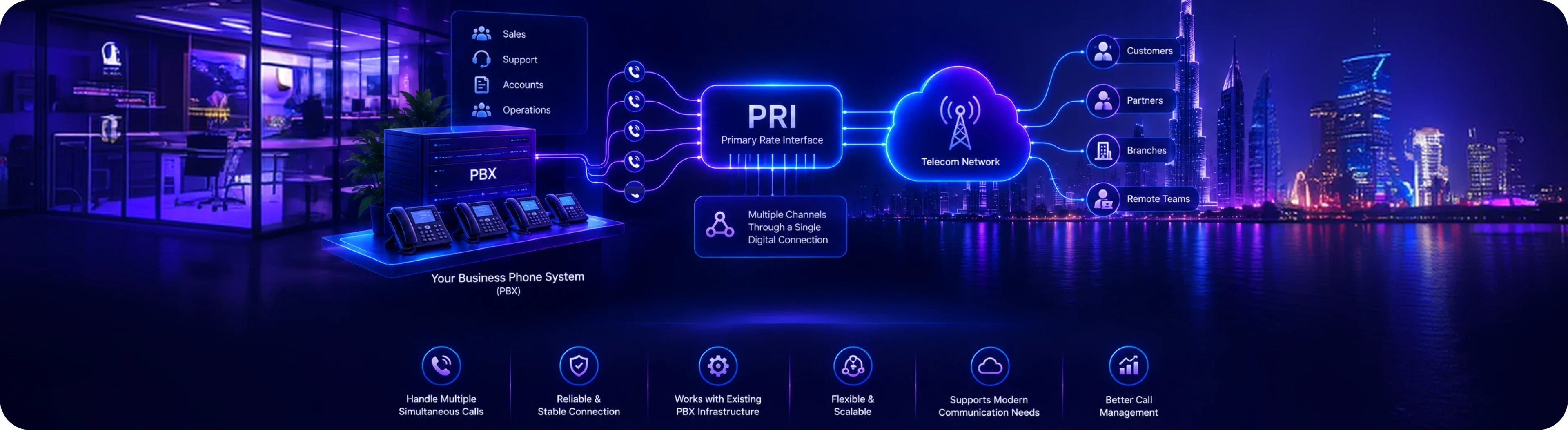
Table of contents
1. What PRI Actually Means
2. Why Businesses in the UAE Have Used PRI
3. Why Businesses Still Search for PRI UAE Services
4. The Biggest Mistake Businesses Make When Choosing PRI
5. 1. Start With Your Current Calling Requirements
6. 2. Check Your Existing PBX
7. 3. Think About Scalability Before Choosing a PRI Service
8. 4. Consider Reliability and Business Continuity
9. 5. Evaluate Call Capacity During Peak Hours
10. 6. Understand the Total Cost of PRI
11. 7. Think About Remote and Hybrid Work
12. 8. Look at CRM and Business Application Integration
13. 9. Consider Call Management Features
14. 10. Think About Your Long-Term Communication Strategy
15. Where PRI UAE Can Make Sense
16. PRI vs Cloud Telephony
17. PRI vs Modern Contact Centre Software
18. What Businesses in the UAE Should Prioritise First
19. What to Ask Before Choosing a PRI Provider in the UAE
20. Why This Matters for UAE SMB and Mid-Market Businesses
21. PRI and the Future of Business Communication in the UAE
22. The Bottom Line
23. Ready to Explore a More Flexible Business Calling Setup?
24. FAQs
For many businesses in the UAE, business calling still plays an important role in sales, customer support, and day-to-day operations.
A company may have a sales team handling customer enquiries, a support team receiving inbound calls, or several departments sharing the same business phone system.
As these teams grow, businesses often need more than just individual telephone lines.
They need a reliable way to handle multiple calls at the same time, manage business numbers, connect their existing phone system to the telecom network, and keep communication running without unnecessary complexity.
That is where PRI UAE, or Primary Rate Interface, comes into the conversation.
PRI has traditionally been used by businesses that rely on PBX-based phone systems and need multiple voice channels through a single digital connection.
But choosing a PRI service is not only about getting more calling capacity.
Businesses also need to think about their existing PBX, number of simultaneous calls, scalability, reliability, maintenance, and whether traditional telephony still fits their long-term communication strategy.
If your business is comparing PRI UAE options, here is what PRI actually means, where it fits, what businesses should consider, and when a modern cloud communication approach may make more sense.
What PRI Actually Means
PRI stands for Primary Rate Interface.
It is a digital communication technology traditionally used to connect a business telephone system, such as a PBX, with the telecom network.
The main idea is simple.
Instead of managing many individual telephone lines separately, PRI provides multiple communication channels through one digital connection.
This makes it possible for businesses to handle multiple calls at the same time while keeping their business telephony environment organised.
For companies with traditional PBX systems, PRI can provide the voice connectivity required for their existing phone infrastructure.
That is why PRI has been widely associated with business telephony, offices, sales teams, and customer support environments.
Why Businesses in the UAE Have Used PRI
The communication needs of a business are very different from those of an individual customer.
A business may have dozens of employees making and receiving calls throughout the day.
Sales representatives may be calling prospects while customer support agents are handling inbound enquiries.
If the company only has a limited number of voice channels, employees may face busy signals, blocked calls, or unnecessary delays.
PRI was designed to help businesses handle multiple simultaneous calls through a structured business telephony connection.
This can make it useful for organisations that already have a traditional PBX environment and want to maintain that infrastructure.
However, modern businesses are also looking for:
cloud-based calling
remote access
better call reporting
flexible user management
AI voice capabilities
easier scalability
That is why businesses should evaluate PRI based on both their current infrastructure and future communication requirements.
Why Businesses Still Search for PRI UAE Services
The interest in PRI UAE is often connected to existing business phone infrastructure.
A company may already have:
a traditional PBX
business telephone numbers
desk phones
established call routing
internal extensions
multiple departments
existing telecom arrangements
Replacing everything at once can create unnecessary disruption.
For this reason, some businesses may still consider PRI when they want to continue using their existing telephone environment.
But this does not mean businesses should automatically choose PRI.
The better approach is to first understand what the business actually needs from its communication system.
The Biggest Mistake Businesses Make When Choosing PRI
One common mistake is focusing only on the number of channels.
A business may say:
"We need more simultaneous calls, so we need PRI."
But simultaneous calls are only one part of the decision.
Businesses should also ask:
How does our current PBX work?
How many employees need calling access?
How many calls happen during peak hours?
Do we have remote employees?
Do we need CRM integration?
Do we need call recording?
Do managers need call reporting?
Are we planning to move to cloud calling?
How quickly will the business grow?
These questions help determine whether PRI is actually the right fit.
The goal should not simply be to add voice channels.
The goal should be to build a communication setup that supports the business.
1. Start With Your Current Calling Requirements
Before choosing a PRI service UAE solution, businesses should understand how their teams currently use calling.
Start by looking at:
number of employees
inbound call volume
outbound call volume
peak calling periods
simultaneous calls
departments using the phone system
existing extensions
current business numbers
For example, a company may have 50 employees but only a smaller number of people making calls at the same time.
Another business may have a sales or support operation where many employees are continuously making and receiving calls.
These businesses have very different requirements.
Understanding actual calling behaviour helps businesses choose appropriate capacity instead of paying for infrastructure they may not need.
2. Check Your Existing PBX
PRI is closely connected with traditional PBX systems.
That means compatibility should be one of the first things a business checks.
Before selecting a provider, businesses should understand:
what PBX system they currently use
whether the PBX supports PRI
what hardware is required
how the PRI connection will be configured
whether additional equipment is needed
whether the existing telephone setup can remain in place
This is especially important for businesses that have invested heavily in their current phone infrastructure.
A compatible PRI setup may allow the business to continue using parts of its existing environment rather than replacing everything immediately.
However, older infrastructure can also create limitations.
Businesses should therefore consider not only compatibility today, but also how long they expect to keep the existing PBX.
3. Think About Scalability Before Choosing a PRI Service
Business communication requirements can change quickly.
A company may start with a small team and gradually add employees, departments, branches, or customer support operations.
This means scalability matters.
Businesses should ask how easily they can increase their calling capacity if demand grows.
They should also understand:
how additional channels are added
how long upgrades take
whether new hardware is required
how expansion affects costs
whether the provider can support multiple locations
A communication system should not become a limitation when the business starts growing.
This is particularly important for UAE SMB and mid-market businesses that may be expanding their teams or opening additional locations.
4. Consider Reliability and Business Continuity
For many businesses, the phone system is part of daily operations.
If customers cannot reach the company, sales teams cannot receive enquiries, or support agents cannot answer calls, business activity can be affected.
That is why reliability should be considered before choosing a PRI UAE provider.
Businesses should ask:
What happens if the connection fails?
What support is available during an outage?
How are technical issues handled?
What service levels are provided?
Is there a backup or continuity option?
These questions help businesses understand how the provider handles unexpected problems.
A reliable business communication setup should not only work during normal conditions.
It should also have a clear approach to service disruption.
5. Evaluate Call Capacity During Peak Hours
The number of simultaneous calls matters.
A business may have normal call activity during most of the day but experience much higher demand during certain hours.
For example, a customer support team may receive a large number of calls during business hours, while a sales team may have specific periods of high outbound activity.
Businesses should therefore look at peak demand rather than only average usage.
The right PRI capacity should support the business when calling activity is highest.
Otherwise, employees may experience blocked or unavailable channels when they need them most.
6. Understand the Total Cost of PRI
The monthly PRI price is not necessarily the complete cost.
Businesses should consider the full cost of running the service.
This may include:
installation
hardware
PBX equipment
maintenance
additional channels
technical support
upgrades
telecom charges
infrastructure changes
This is why businesses should evaluate the total cost of ownership rather than looking at one monthly number.
An existing PBX may also require ongoing maintenance and support.
When comparing PRI UAE with modern cloud communication options, businesses should look at the complete financial picture.
7. Think About Remote and Hybrid Work
The way businesses work has changed significantly.
Employees may no longer work from one office every day.
Sales representatives may work remotely.
Support teams may be distributed across locations.
Managers may need to monitor communication activity from different places.
Traditional PBX environments can be less flexible in these situations because they are often designed around a physical office setup.
Businesses considering PRI should therefore ask how remote employees will access business calling.
If employees need separate tools or complicated workarounds to make business calls outside the office, it may be worth evaluating a cloud-based communication model.
8. Look at CRM and Business Application Integration
Business calling is increasingly connected with other business systems.
Sales teams may use CRM platforms to manage leads and customer information.
Support teams may use helpdesk systems to track customer issues.
When calling and business applications are connected, employees can have more context around customer interactions.
Businesses should therefore consider whether their communication setup can support:
call logging
customer information
CRM integration
reporting
call activity tracking
automated workflows
PRI mainly provides voice connectivity.
Additional platforms or integrations may be required to create a more connected communication workflow.
This distinction is important for businesses that want more than traditional calling.
9. Consider Call Management Features
A business phone system is not only about connecting two people on a call.
Businesses may need to manage what happens before, during, and after the call.
This can include:
IVR
call queues
call forwarding
business-hours routing
voicemail
call recording
call monitoring
reporting
team-based routing
These features become particularly important for sales and support teams.
A traditional PRI setup may provide the underlying voice connectivity, but businesses should separately evaluate the platform and features used to manage customer communication.
10. Think About Your Long-Term Communication Strategy
The most important question may be:
Where does your business want its communication system to be in the next few years?
If the business already has a traditional PBX and plans to continue using it, PRI may fit into that environment.
But if the company wants to move toward cloud communication, remote working, CRM integration, AI voice, and advanced analytics, it should also evaluate modern alternatives.
Technology decisions should support business direction.
Choosing a solution only because the company already uses it can make sense in the short term, but it may create limitations later.
Where PRI UAE Can Make Sense
PRI can still be relevant for businesses that have established traditional telephone infrastructure and need multiple voice channels.
It may be considered by businesses that:
already use a traditional PBX
need multiple simultaneous calls
have established office-based telephony
want to continue using existing infrastructure
have predictable calling requirements
are not ready for a complete cloud migration
The right choice depends on the individual business.
For some companies, continuing with an existing PBX and PRI environment may be practical.
For others, moving towards cloud calling may provide a more flexible foundation for future growth.
PRI vs Cloud Telephony
One of the biggest questions businesses may have is whether they should continue with PRI or move towards cloud telephony.
PRI is designed around traditional business telephone infrastructure and PBX systems.
Cloud telephony moves the communication layer into a cloud-based environment.
This can provide businesses with greater flexibility for:
remote employees
multiple offices
mobile users
CRM integrations
flexible user management
cloud-based workflows
This does not mean cloud telephony is automatically better for every company.
Businesses should consider their current infrastructure, requirements, budget, migration plans, and future strategy.
The important thing is to understand the difference before making a long-term decision.
PRI vs Modern Contact Centre Software
For sales and support teams, the comparison goes beyond PRI and cloud telephony.
A modern contact centre platform can provide a broader operating layer around customer communication.
This can include:
call routing
queues
IVR
dashboards
agent management
call recording
CRM integration
analytics
AI voice
post-call insights
PRI can provide voice connectivity for a traditional environment, but contact centre software focuses on how customer interactions are managed.
This distinction matters for businesses where calling directly affects sales, support, and customer experience.
What Businesses in the UAE Should Prioritise First
If your company is evaluating PRI UAE, start with the business requirement rather than the technology.
Ask:
How many simultaneous calls do we need?
What PBX system are we currently using?
Do we need to keep our existing business numbers?
How much will our calling requirements grow?
Do remote employees need access?
Do we need CRM integration?
Do managers need better reporting?
Are we planning to move towards cloud communication?
What will the complete cost be?
What support will the provider provide?
The answers will make it easier to determine whether PRI is the right option or whether a modern cloud communication solution would be more suitable.
What to Ask Before Choosing a PRI Provider in the UAE
Before signing an agreement, businesses should ask potential providers clear questions.
For example:
Is the PRI service compatible with our existing PBX?
How many simultaneous calls can we support?
How easily can we add more capacity?
What installation is required?
What hardware is required?
What are the monthly and setup costs?
What support is included?
What happens during service disruption?
Can we keep our existing business numbers?
What options are available if we later move to cloud telephony?
Getting clear answers early can help businesses avoid unexpected costs and infrastructure problems later.
Why This Matters for UAE SMB and Mid-Market Businesses
For SMB and mid-market businesses in the UAE, communication infrastructure needs to balance reliability, cost, flexibility, and growth.
A business may start with a traditional PBX because it provides the calling capabilities the company needs at that stage.
But as the company grows, its requirements can change.
More employees may need calling access.
More departments may depend on customer communication.
Remote and hybrid teams may become part of the organisation.
Sales teams may need CRM-connected calling.
Support teams may need better reporting and routing.
At that point, the business needs to think beyond basic voice connectivity.
That is why choosing PRI UAE should involve both the current setup and the future communication strategy.
PRI and the Future of Business Communication in the UAE
The UAE business environment continues to move towards more flexible and connected communication.
Businesses increasingly want to combine calling with:
cloud platforms
CRM systems
analytics
automation
AI voice
remote working
customer support workflows
This does not make traditional telephony irrelevant overnight.
Many businesses still have existing infrastructure that needs to be supported.
But it does mean companies should consider whether their current communication model can support the direction they want to take.
For some businesses, PRI may remain part of the current environment.
For others, cloud telephony or contact centre software may provide a more flexible path forward.
The Bottom Line
PRI UAE can provide businesses with multiple voice channels and connectivity for traditional PBX-based telephone environments.
For companies that already have established telephony infrastructure, PRI may still be a practical option.
But businesses should not choose PRI based only on the number of available channels.
They should also evaluate PBX compatibility, call capacity, reliability, scalability, total cost, remote work requirements, integrations, and long-term communication goals.
If your business mainly needs traditional voice connectivity, PRI may fit the requirement.
If your business is looking for more flexible calling, CRM integration, remote access, analytics, or AI-powered communication, it may be worth evaluating modern cloud-based alternatives as well.
The right decision is not about choosing the newest technology.
It is about choosing the communication model that fits how your business operates today and where it wants to go next.
Ready to Explore a More Flexible Business Calling Setup?
Voiger helps businesses modernise customer communication with flexible cloud calling and contact centre solutions designed around real sales and support requirements.
If your business is evaluating PRI UAE, traditional PBX connectivity, or a move towards modern cloud communication, book a demo with Voiger to explore the right approach for your business.

Frequently asked questions
Everything you need to know about Voiger Voice Platform.
PRI stands for Primary Rate Interface. It is a digital telecommunication technology traditionally used to connect business PBX systems with the telecom network and support multiple simultaneous voice calls.
PRI is used to provide multiple voice channels for business telephone systems. It can be used by companies that need several employees to make and receive calls at the same time.
PRI UAE refers to PRI-based business telephony services available for businesses operating in the UAE, particularly those using traditional PBX infrastructure.
It depends on the business's calling requirements and existing infrastructure. A small business with a compatible PBX and a need for multiple simultaneous calls may consider PRI, while businesses looking for flexible cloud communication may prefer other options.
Yes. PRI is traditionally used with compatible PBX systems. Businesses should confirm that their existing PBX supports the required PRI configuration before choosing a service.
Not necessarily. PRI can be suitable for businesses with established traditional PBX infrastructure, while cloud telephony can offer greater flexibility for remote teams, integrations, and future growth.
Businesses should check PBX compatibility, call capacity, reliability, scalability, installation requirements, total cost, technical support, and their long-term communication strategy.
PRI may still make sense for businesses that rely on traditional PBX infrastructure. However, companies planning to modernise their communication environment should also evaluate cloud telephony and contact centre solutions before making a long-term decision.
SIP Trunking UAE: Complete Guide to Business Communication
August 25, 2026
NaaS UAE: What Growing Businesses Should Know Before Adopting Network as a Service
August 20, 2026
Cloud PBX UAE vs Cloud Contact Centre: Which One Does Your Business Actually Need?
August 13, 2026